Every child learns
differently.
So should their
preparation.
We're studying how a short 10-minute warm-up before a learning session can help children with autism engage more — and finding the right warm-up for each individual child.
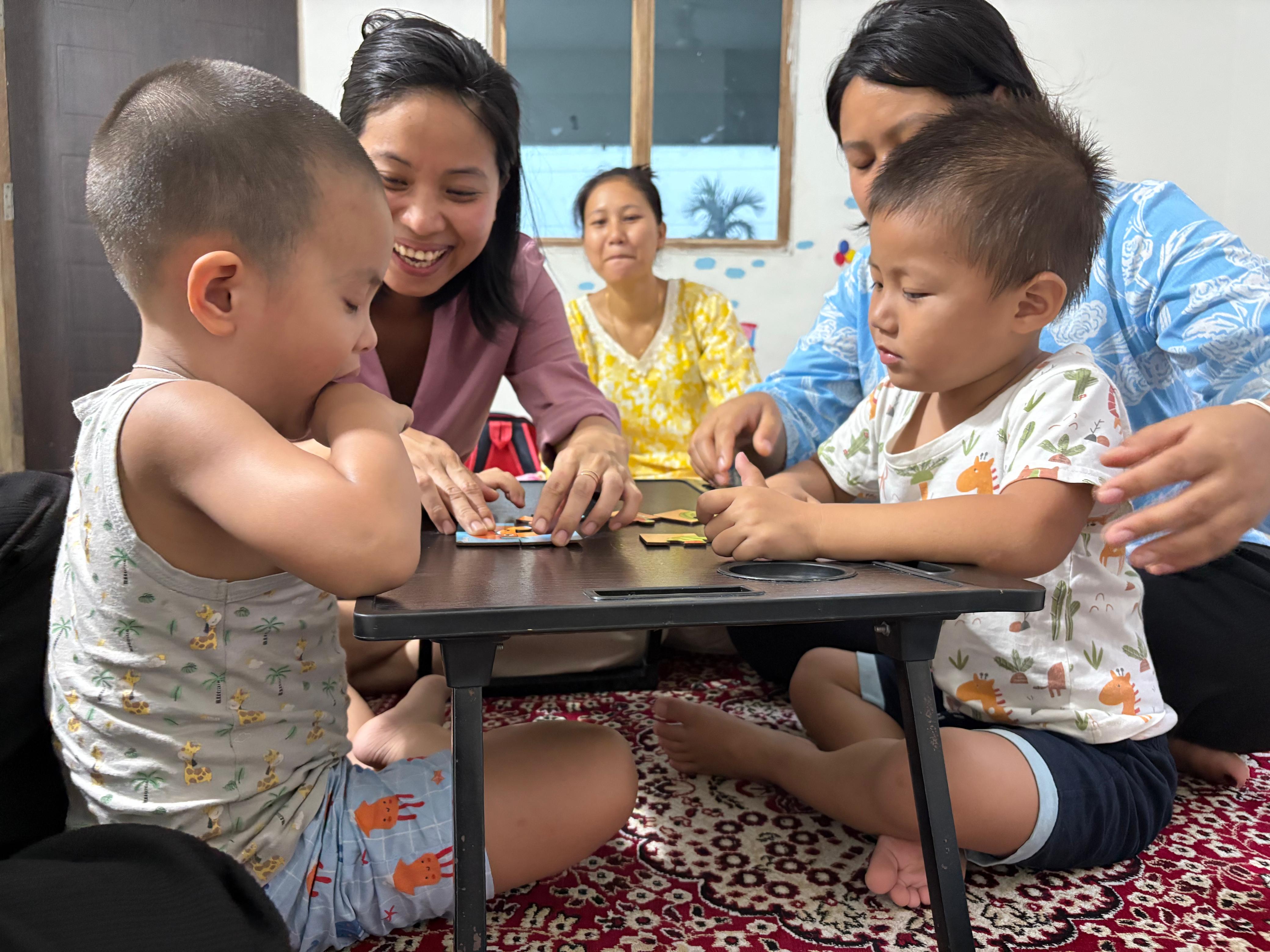
The Setting
Clinical Context: Maya Care and Grow
In Agartala, India, early autism intervention requires a highly individualized approach. Our study is integrated directly into the daily routines of a center serving 25 children with diverse developmental profiles.
Children aged 3 to 14 attend 2–16 hours of learning sessions per week. In this setting, the first 15 minutes are critical; practitioners currently use a variety of activities to 'prepare' a child for learning.
While these preparations—ranging from massage and bubbles to puzzles and music—are delivered with expert judgment, there is currently no data-driven way to know which specific activity maximizes engagement for a specific child.
The Opportunity
- 📍 Real-world setting with routine delivery
- 📊 Feasible data collection via practitioner involvement
- 🔄 Repeated-measures design for highly variable responses
- 🎯 Personalized results for every enrolled child
"Every child responds differently. Our goal is to replace intuition with evidence."
The Challenge
Why does preparation matter?
Children with autism often experience challenges regulating their sensory systems before a learning session. A child who arrives overwhelmed, under-stimulated, or dysregulated may struggle to engage — not because of the content, but because of how they feel. A brief, targeted warm-up can help bridge that gap. But the right warm-up isn't the same for everyone.
Individualized by design
Each child serves as their own control. We compare all four conditions within the same child across sessions, so results aren't muddied by differences between children.
Bayesian learning
Our statistical approach gives probabilities, not just yes/no answers. We can say "there's an 85% chance Condition A is best for this child" — and stop as soon as we're confident enough
Adaptive & humane
We stop testing a child the moment we have a clear answer, or if any condition consistently distresses them. No child is kept in an ineffective routine for longer than necessary.
The Interventions
Four preparation conditions
Each child is assigned one fixed activity per condition before the study starts. The 20-minute learning session that follows is identical each time — so any difference in engagement can only be due to the warm-up.
High-Energy Input
⚡ Jumping & Body Massage
Targets the vestibular and proprioceptive systems with movement and deep pressure. Ideal for children who are under-aroused or need activation before learning.
⏱ 10 minutesQuiet & Fine Motor
🌿 Clay Modelling
Gentle tactile input designed to reduce arousal. Well-suited for children who arrive hyperactive, anxious, or sensory-overloaded and need to settle before learning.
⏱ 10 minutesAutonomy & Choice
🎯 Choice Board
The child selects their own warm-up from a fixed menu of options. Builds agency and intrinsic motivation — a key factor in engagement for many children with autism.
⏱ 10 minutesNo Preparation
— Standard Session Start
The session begins immediately with no warm-up. This is the current standard of care and serves as our baseline for comparison. It may turn out to be optimal for some children.
⏱ 0 minutesProcess
How does a session work?
A typical session takes about one hour. The order of conditions across sessions is randomized — a bit like shuffling cards — so no child gets the same warm-up two sessions in a row.
Child arrives at the centre
The rater (a trained observer who scores engagement) notes the child's arrival state: calm, tired, or hyperactive. This is recorded but does not change the assigned condition.
Observation10-minute warm-up (or none)
The practitioner delivers the assigned preparation condition — Stimulating, Calming, Child-Led, or skips it entirely. The activity is one the child already does at the centre.
InterventionStandardized learning block
The same structured curriculum — specific Discrete Trial Training tasks or tabletop work — is used in every session. The rater observes from a separate room, scoring engagement at 5, 15, and 30 minutes.
Learning sessionEngagement is scored (1–10)
The rater assigns a BRES-10 score. The three scores are averaged into a single composite for that session. 20% of sessions are double-scored for reliability checks.
MeasurementWeekly Bayesian check
Every Sunday, the model evaluates each child's data. If we're ≥90% confident in a winner — or confident that no prep truly makes a difference — we stop and implement the personal recommendation immediately.
Stopping ruleMeasurement
What does the engagement score mean?
The BRES-10 (Blinded Rater Engagement Scale) is a 1–10 scale scored by a trained observer who does not know which warm-up condition was assigned. Higher scores mean more independent, sustained engagement.
Your Child's Wellbeing
Safety comes first
This study uses only activities already practiced at Maya Care and Grow. Every safeguard below is active from the first session.
Automatic condition removal
If a child scores ≤ 2 (active refusal/distress) for three consecutive sessions under any condition, that condition is immediately removed from their rotation. Parents are notified.
Voluntary participation
Participation is entirely voluntary. Withdrawing at any time has zero effect on your child's access to services or quality of care at the centre.
Early stopping
As soon as the model is confident in a recommendation, randomization stops immediately — your child doesn't continue in an experimental condition longer than needed.
No novel interventions
All four conditions are existing activities at the centre. We are not introducing anything new — only studying the timing and type of familiar activities.
Ethical framework
The study follows the Declaration of Helsinki. Written parental consent is required, and children's assent is sought in an age-appropriate way before enrolment.
Blinded scoring
The person scoring engagement does so from a separate room without knowing which warm-up was given — reducing the risk of biased observations.
Child Archetypes
What response patterns do we expect?
Based on clinical knowledge of this setting, we anticipate children will fall into four profiles. The study is designed to detect meaningful differences for each type.
One preparation type is clearly and substantially better. The model typically resolves these children within 20 sessions.
SuperiorityA best condition exists but the effect is modest. Requires more sessions to separate signal from noise.
Superiority or AIPETwo or more warm-up types are equally beneficial. The recommendation is: 'use whichever is convenient.' Most children are expected to fall here.
AIPE criterionThis child arrives well-regulated and doesn't need a warm-up. No Preparation is perfectly valid — and affirmed as a clinical choice.
ROPE criterionSimulated Power Analysis
How confident will we be, and when?
Before collecting any data, we ran computer simulations to confirm the study can deliver reliable answers. These charts show how resolution rates grow with more sessions — and how they differ by child type.
Resolution Rate by Sessions
Proportion of simulated children with a confirmed recommendation
Resolution by Child Profile at 32 Sessions
Performance varies by how distinct the best preparation is
Illustrative Group-Level Results
Simulated model output (900 observations, 25 children) — estimated benefit of each condition vs. No Preparation
Methodological Rigor
Stability & Sensitivity
We performed 'stress-tests' on our statistical models to ensure clinical recommendations are driven by the child's actual progress, not by background noise or mathematical assumptions.
🌪️ Environmental Robustness
We tested the model by removing information about the child's age and the specific teacher.
Result: Clinical recommendations remain identical even when ignoring environmental covariates.
⚖️ Decision Stability
We re-ran the study using other mathematical assumptions (Bayesian priors) to see if the outcome changed.
The Qualitative Safety Net: In cases where a recommendation is mathematically "fragile" (sensitive to assumptions), the Principal Investigator and Lead Practitioner conduct a manual review of session notes before finalizing the clinical assignment.
Results
Predictive Power & Personalized Insights
Data collection is in progress — we'll update this section in June.
Open Science
Research & Transparency
We are committed to full transparency. Below you can find the source code, pre-registered protocols, and the technical reports that validate our statistical approach.
Questions & Answers